 Velocity Partners

The AI Range: Building AI Skill Through Reps
Most professionals now have access to capable AI tools. Far fewer get real value from them. The gap usually isn't access, and it isn't technical skill. It's habit: noticing the moments in everyday work where AI could help, and knowing which questions to ask when it does.
Habits are built the way any skill is built: with repetition. Nobody swings a golf club once and expects to break 90. It takes hundreds of swings before contact is consistent and thousands before the motion is automatic. Yet many people try an AI tool twice, get a mediocre answer, and conclude it isn't that useful. That's judging golf after two swings at the range.
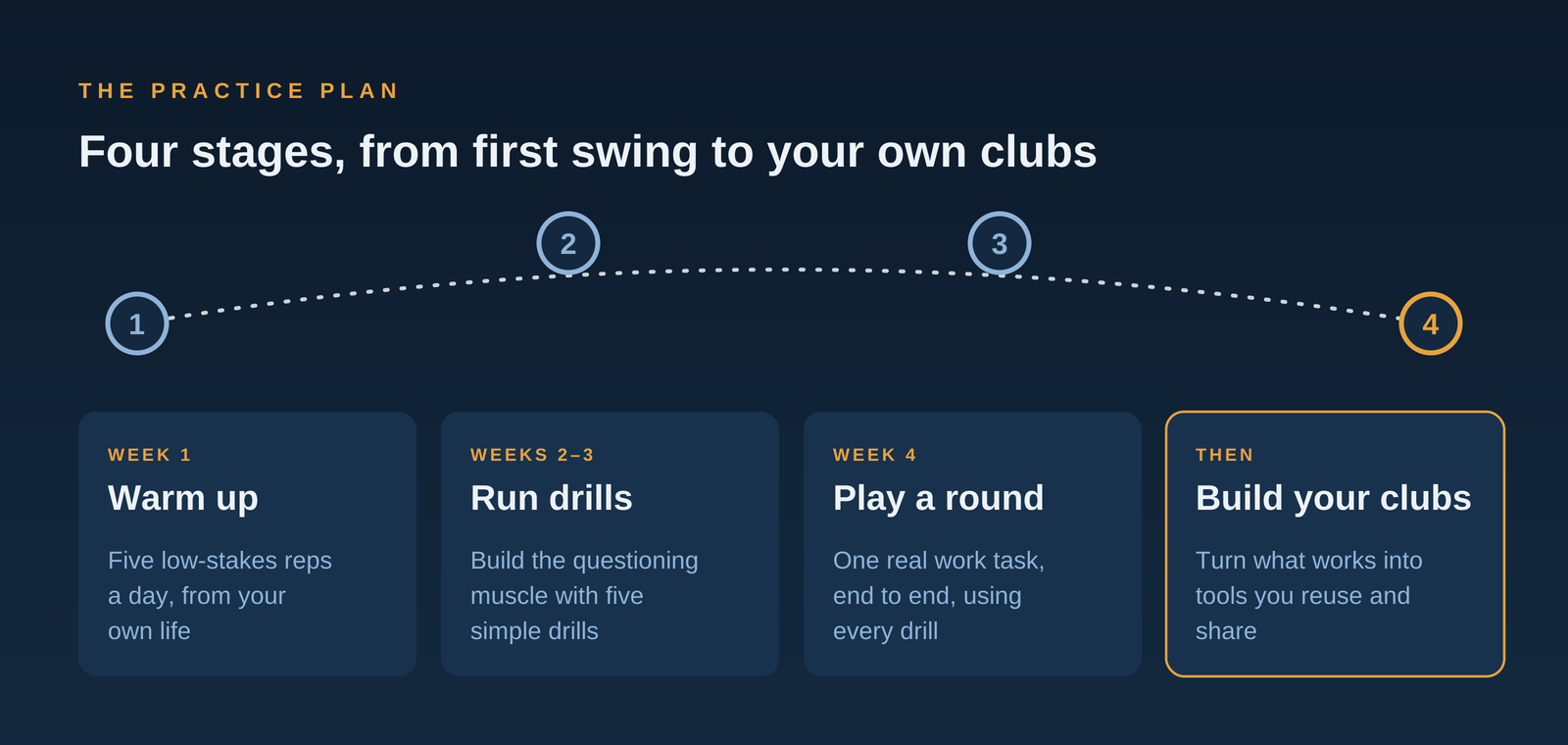
Here is a practice plan for the range: what to work on, and in what order.
Why practice outside the office first
The habit of spotting where AI can help is best built as a life skill you bring to work, not an office skill you learn in a workshop. In your personal life the stakes are lower, the feedback is instant, and you'll get far more reps in. The reflex transfers.
It's also why a two-hour corporate training session rarely changes behavior. A workshop can teach a tool. Only reps install a reflex.
Before you start: pick your bag
One general AI assistant is enough. Claude, ChatGPT, Gemini, and Copilot all have free tiers that work well for practice. Pick one and stay with it for a month. You're building a swing, not shopping for clubs.
Week 1: Warm up
Five low-stakes reps a day, drawn from your own life:
- Plan something: a weekend, a trip, or a week of meals.
- Draft the email you've been putting off, then ask for a shorter version and a kinder one.
- Paste in a confusing letter, bill, or policy and ask what it actually says.
- Ask it to explain a term you nodded along to in a meeting, and keep asking until it clicks.
Weeks 2–3: Run drills
The difference between a mediocre AI answer and a great one is usually the question, not the tool. Five drills build the questioning muscle:
- Ask a second question. Never stop at the first answer. Ask "What did you assume?" or "What would make this better?"
- Switch the persona. "Critique this as a skeptical CFO." Then as a new customer. Then as your toughest competitor.
- Flip it. Ask how the plan fails, not how it succeeds. It surfaces the risks nobody put on the slide.
- Make it interview you. "Ask me five questions before you answer." Its questions show you what you hadn't thought through.
- Ask what's missing. "What should I be asking that I haven't?" It feels odd the first time. Do it anyway.
Week 4: Play a round
Take one real work task end to end: a proposal, an analysis, a plan you'd write anyway. Use the drills at every step, then compare the result and the time it took with the old way. Keep a running note of what worked. After a month, it's a map of where AI can help your team.
Two rules for every session
- Verify anything that matters. A confident answer isn't a correct one.
- Protect confidential data. Don't put company information into tools your company hasn't approved.
Set a number
Pick a number of reps a day and raise it every week: five in the first week, ten in the second. The point isn't productivity. It's noticing the moments, and asking better questions once you do.
Next in the series: Give AI More to Work With →
Want to build these habits across your team? Book a 20-minute call.